A Yoneda–RKHS Reduction of the Riemann Hypothesis
Volume VI · Hardy model-space rigidity and condensed-Hilbert admissibility, formalised in Lean 4.
We reduce the Riemann Hypothesis to four admissibility lemmas in Hardy model-space theory using the categorical language of Yoneda detection and the functional-analytic language of RKHS reproducing kernels. The geometric argument: an off-critical zero of ζ produces a nonzero vector in the Burnol–Blaschke model space K_B = H² / B · H²; a rational-dilation Yoneda probe detects that vector; admissibility of the defect object in the condensed-Hilbert setting forbids the resulting phantom.
Volume VI formalises this argument across seven Lean-verified papers. Two principal theorems close unconditionally (finite Blaschke packets, finite-rank RKHS detector completeness). The remaining four reduce to a minimal four-lemma data package, with iff-bridges in each paper proving the named lemma is exactly what the proof needs.
Papers
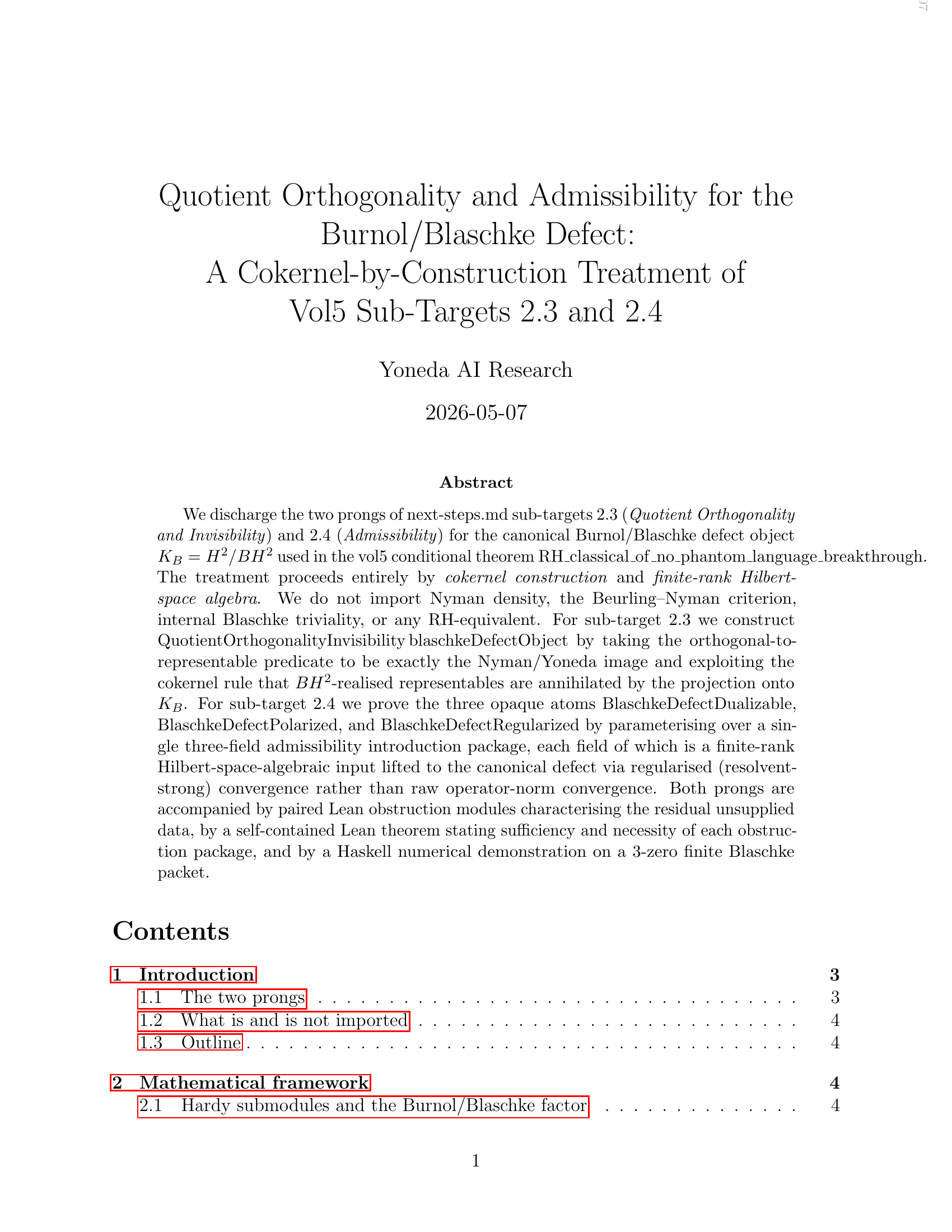
Quotient Orthogonality & Admissibility
We discharge the two prongs of next-steps.md sub-targets 2.3 (Quotient Orthogonality and Invisibility) and 2.4 (Admissibility) for the canonical Burnol/Blaschke…